Quick answer: Answer engine optimization (AEO) for a dental website means making patient questions easy to answer accurately on the page. Use descriptive question headings, an immediate plain-language answer, supporting detail reviewed by a qualified dental professional, transparent practice information, and crawlable pages. These practices can help people and search systems understand content, but no technique guarantees a mention in an AI-generated answer.
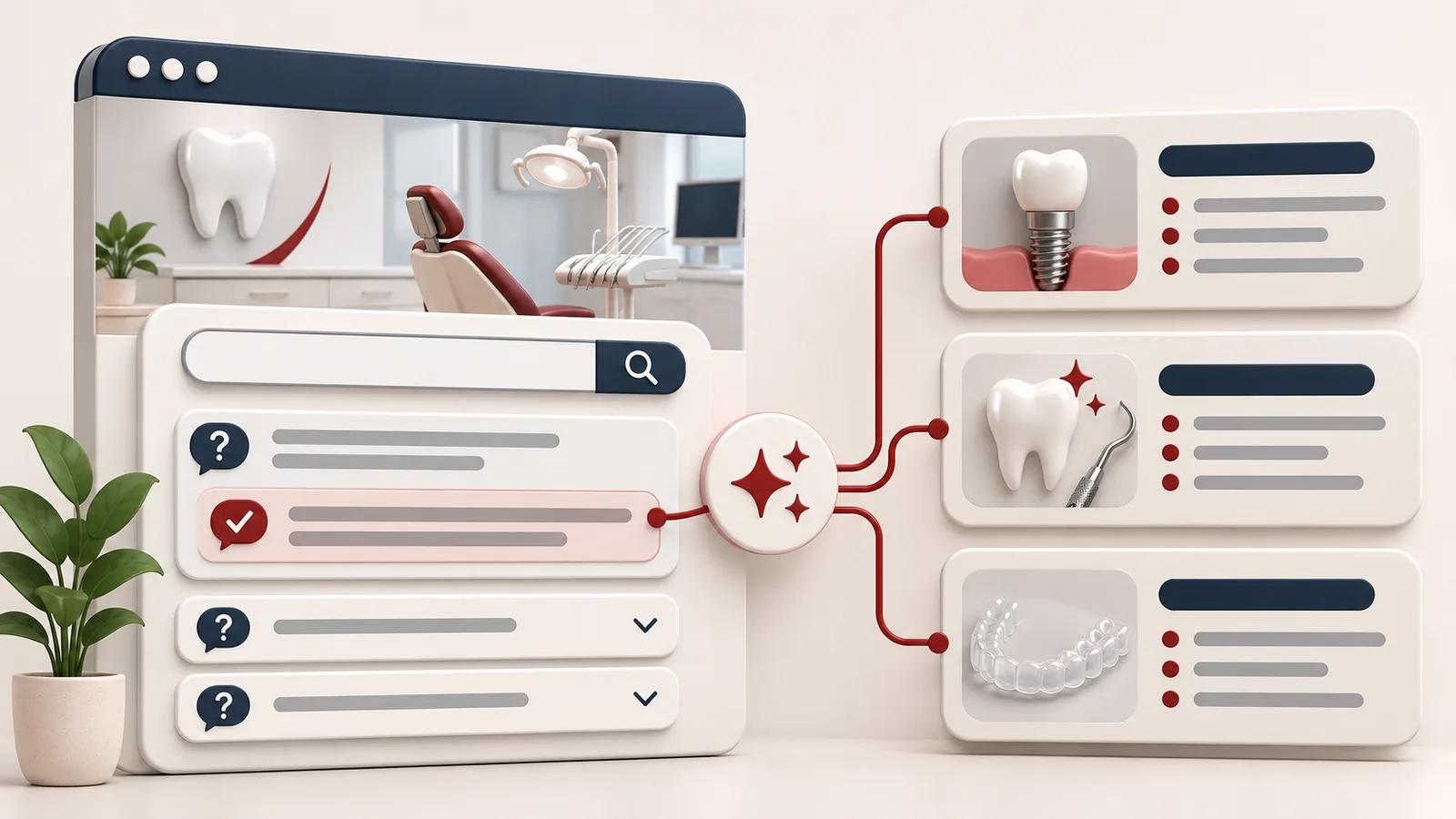
Question-led content can help patients find the useful explanation without reading an entire marketing brochure.
A prospective patient may ask “How long does a dental implant consultation take?”, “Can I get a cleaning if I am a new patient?”, or “What should I do about a chipped tooth?” Some search experiences display AI-generated summaries or answers, but the underlying requirement remains the same: trustworthy, accessible, genuinely helpful information.
Google's guidance for AI features emphasizes foundational SEO and people-first content—not a separate set of shortcuts. It also cautions against making pages merely to chase the latest search presentation. For a dental clinic, that means answering real questions responsibly, including explaining when advice depends on an individual examination.
What is the difference between SEO and AEO on a dental website?
SEO helps a useful page become discoverable and understandable in search. It includes crawlability, relevant wording, quality content, links, performance, and other signals. AEO is a practical editorial emphasis within that work: state the answer clearly enough that a person or automated system can identify it and see its context.
For example, a page titled “Dental Implants” may contain a long introduction before explaining the consultation. An answer-first version could include the heading “What happens during a dental implant consultation?” followed by two accurate sentences, then details about exam, imaging when appropriate, treatment planning, and what varies by patient. The second version serves that particular question better—without needing to repeat the phrase dozens of times.
A four-part structure for patient questions
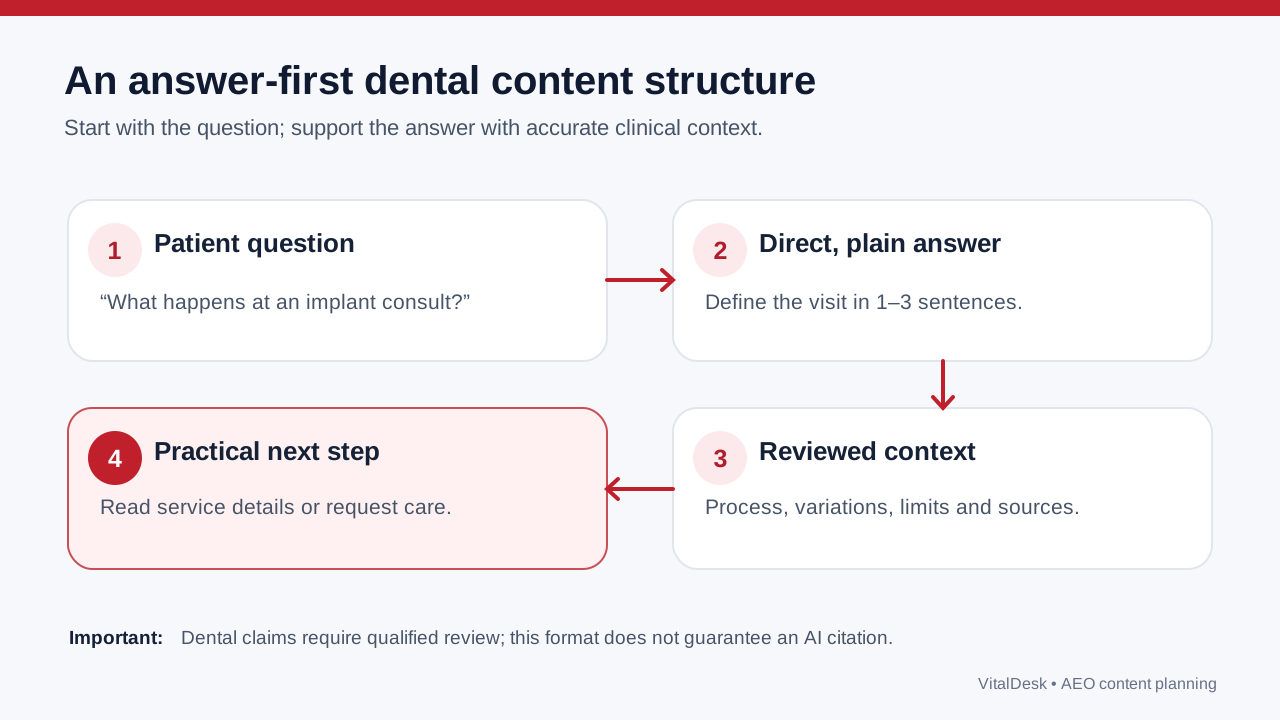
A useful dental answer includes context and limits—not just a sentence optimized to be extracted.
- Use the patient's natural question. Example: “How is a dental crown different from a filling?”
- Answer in the next one to three sentences. Use language a new patient can understand, with no unsupported superlatives.
- Explain the relevant context. Include eligibility, steps, potential variations, and when a dentist needs to examine the patient before advising.
- Offer a sensible next step. Link to the related service page or evaluation request; avoid turning every paragraph into a sales pitch.
The answer should be correct when read alone, but not so stripped down that it becomes misleading.
Six kinds of questions dental practice pages should answer
These examples are editorial prompts, not clinical advice to publish without review:
| Patient question | Useful information to provide | Appropriate destination |
|---|---|---|
| What happens at a first dental appointment? | Check-in, history review, examination process, what to bring | New Patients page |
| Does a dental implant require a consultation? | Evaluation, treatment planning, factors affecting suitability | Implant service page |
| Can I book a cleaning online? | New/returning rules, service types, whether request or confirmed | Scheduling page |
| What if I need urgent dental care? | Office hours, contact route, when to seek urgent medical help | Emergency dentistry page |
| Do you offer clear aligners? | Whether offered, consultation steps, factors evaluated | Orthodontic service page |
| Which insurance plans do you accept? | Verified participation information and how to confirm benefits | Insurance / Payment page |
For health-related questions, a qualified dental professional should approve the medical explanation. If the answer varies by the patient's condition, say so. Do not promise outcomes, healing times, coverage, or eligibility without sufficient context.
How to make dental answers discoverable
1. Write descriptive titles and headings
Use a page title such as “Dental Cleaning for New Patients in [City]” when that accurately reflects the service. Add logical H2/H3 headings phrased around actual questions. Do not repeat a keyword unnaturally or create dozens of nearly identical pages.
2. Keep answers in accessible page text
Important explanations should exist as real, readable text on a crawlable URL. Do not hide the only answer in an image, a hover effect, or content that loads only after a restricted interaction. Use an HTML image element and meaningful alt text for supporting imagery.
3. Link related concepts together
A cleaning article can link to the preventive dentistry page, New Patients information, and the booking process. The anchor text should tell readers where they will go. Useful internal linking also helps search engines discover supporting pages.
4. Attribute expertise and review content
For clinical articles, publish accurate author or reviewer information only when true, including credentials and review dates when available. Cite relevant authoritative guidance, label informational content appropriately, and update pages when care recommendations or practice policies change.
5. Be precise about what the practice offers
Generic educational content cannot replace real business details. Specify whether a service is available at a location, whether the page is educational, and how patients can request an evaluation. Avoid copying another clinic's FAQ if its hours, pricing, or services are different.
6. Keep schema accurate and expectations realistic
Structured data such as Article, BreadcrumbList, or an appropriate local business type can describe genuine visible page information when implemented correctly. Schema does not guarantee AI citations or rich results. Google discontinued FAQ rich results in May 2026, so writing FAQs remains useful for patients, but FAQ rich-result visibility should not be sold as a current feature.
A concrete before-and-after example
Less helpful: “Our innovative dentists offer the best implants at affordable rates. Contact us today.”
More helpful: “A dental implant consultation is an appointment to evaluate whether implant treatment may be appropriate for you. The dentist reviews your goals, oral health, and any imaging needed for planning. The recommended treatment and timeline depend on the examination.”
The second paragraph gives a useful definition, explains the clinic's evaluation process, and avoids unsupported promises. It can be followed by details specific to the practice, clinician-reviewed guidance, and a booking request.
What about voice search and AI assistants?
Patients use conversational language with phones and assistants. Organizing pages around clear questions can serve those people too. Still, there is no reliable “voice search ranking trick” or special text file that ensures a dental clinic will be recommended by an assistant.
Measure what is measurable: whether relevant pages are indexable, whether organic visitors find the answers, which questions reach your front desk, and how often pages lead to appropriate inquiries. AI-generated result appearance and attribution can vary and should not be represented as a guaranteed channel.
For service pages and real-world patient conversion, see the dental website design checklist. For geographic search intent, read local SEO for dental clinics.
Frequently asked questions about dental AEO
Will FAQ sections make my dental clinic appear in AI Overviews?
No placement is guaranteed. Helpful, crawlable, original answers may be easier to understand, but Google's systems decide when and how sources appear. FAQ rich results are a separate search feature and were discontinued in 2026.
Should we add an llms.txt file for AEO?
There is no established requirement that a special llms.txt file is needed for Google AI search visibility. Focus first on accessible pages, useful content, correct technical SEO, and genuine expertise.
Can an AI tool write all our dental treatment explanations?
It may help draft structure, but dental claims, contraindications, urgency guidance, credentials, and practice policies require human verification. For health information, accuracy and appropriate clinical review matter more than publishing volume.
How many questions should go on each service page?
Only as many as are genuinely helpful. Start with common pre-appointment questions your reception team hears. Group related answers and avoid adding repetitive sections solely to increase word count.
Build answers into a customized dental website
VitalDesk's customized website services can support a patient-focused information architecture: clear treatment pages, relevant FAQ content, local details, and straightforward ways to contact or request an appointment. Dental clinical content should remain subject to the practice's professional review, and no AI-search placement can be promised.
Next step: See how VitalDesk approaches customized clinic websites and plan pages around questions your actual patients ask.
Editorial references: Google: AI features and your website; Google Search Essentials; Google Search Central updates; W3C informative images and alt text.
Plan your custom dental website
Discuss the practice services, patient questions, booking workflow and location details that your website needs to communicate.
Explore custom websites