Quick answer: Local SEO helps a dental practice become easier to find and evaluate in location-based searches. Start with an accurate Google Business Profile, a crawlable website with real service and location information, consistent business details, and genuine patient reviews. Then make it simple to call or request an appointment. No agency or website can guarantee a top position in Google Maps.
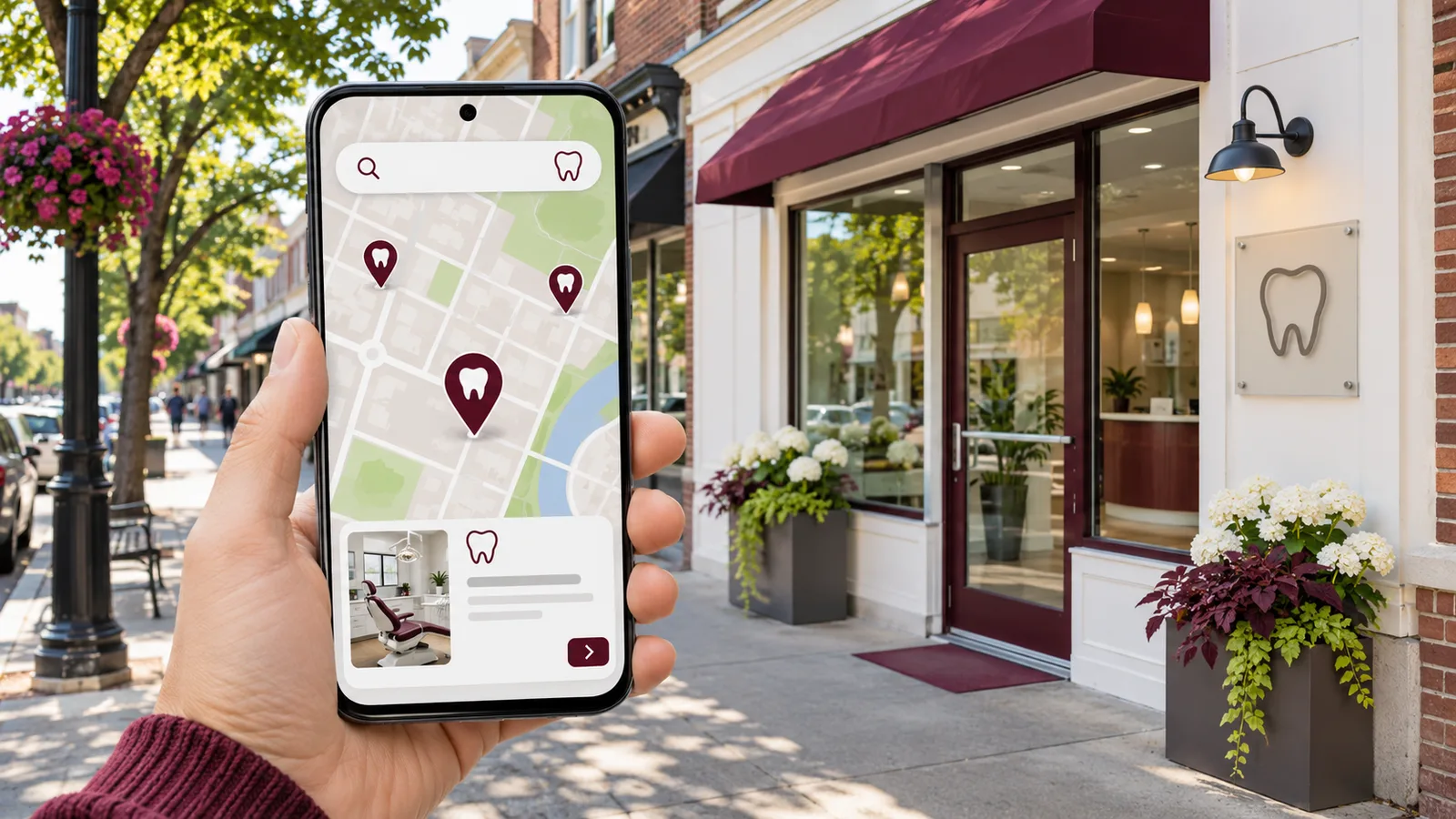
Local search happens in context: patients want an appropriate service, a real nearby location, and a way to contact the office.
When someone searches “dentist near me” or “teeth cleaning in [city],” Google is trying to connect the query with relevant places. That makes Google Business Profile, local website content, and reputation important parts of the same patient journey. Search visibility still depends on competition, user location, and Google's systems; it is not purchased as a guaranteed rank.
How does Google decide which dental practices appear locally?
Google describes local result ranking primarily through three factors:
- Relevance: how closely the business matches the search.
- Distance: how close the business is to the searcher or stated location.
- Prominence: how well known the business appears to be, informed by signals such as links and reviews.
A clinic cannot change its physical distance from every searcher. It can accurately describe its services, verify its location details, maintain its website, and encourage authentic reviews without incentives or manipulation. Google says there is no way to request or pay for a better local ranking.
Step 1: Make your Google Business Profile accurate and complete
Verify that the profile belongs to the real practice and has the correct primary category, street address or eligible service-area configuration, phone number, hours, holiday hours, website, appointment URL, and services. Add current photos of the practice and update details whenever something changes.
Avoid keyword-stuffing the business name. If the official practice is “Riverside Family Dental,” use that name rather than adding an invented string of cities and services. Profiles should reflect the real-world business.
For multi-location dental groups, keep the profiles distinct and accurate. Do not create imaginary offices or doorway profiles for neighborhoods where no eligible practice location exists.
Step 2: Build helpful pages for the services you actually offer
A single “Our Services” page is often too vague to answer intent-specific queries. For your highest-priority services, write distinct pages that explain the treatment in patient-friendly language and reflect actual availability at that clinic. Useful examples might include:
| Patient query | Page that could satisfy it | Important information to include |
|---|---|---|
| “Emergency dentist in [city]” | Emergency dental care | Phone, hours, urgent-visit policy, location, emergency instructions |
| “Dental implants near [area]” | Dental implant consultation | Evaluation process, suitability factors, clinician review, appointment request |
| “Kids dentist in [city]” | Pediatric or family dentistry, if offered | Age ranges treated, clinician credentials, first-visit expectations |
| “Dental cleaning near me” | Preventive care / cleanings | What's involved, new-patient process, booking options |
Do not create thin pages for every nearby town with the same paragraphs and a swapped city name. A page should exist because it serves a real location or meaningful patient need.
Step 3: Make location pages genuinely useful
If your practice operates in two physical offices, each location page should include its verified address, phone, hours, providers or services where they differ, directions, parking or transit notes, and a booking path tied to that location. A staff member should be able to verify every detail.
It may make sense to provide an office-specific page for each practice, but that does not mean creating dozens of duplicate “dentist near [suburb]” pages. Strong local content is grounded in a real service area and a real business, not a list of keyword variations.
The local dental search ecosystem
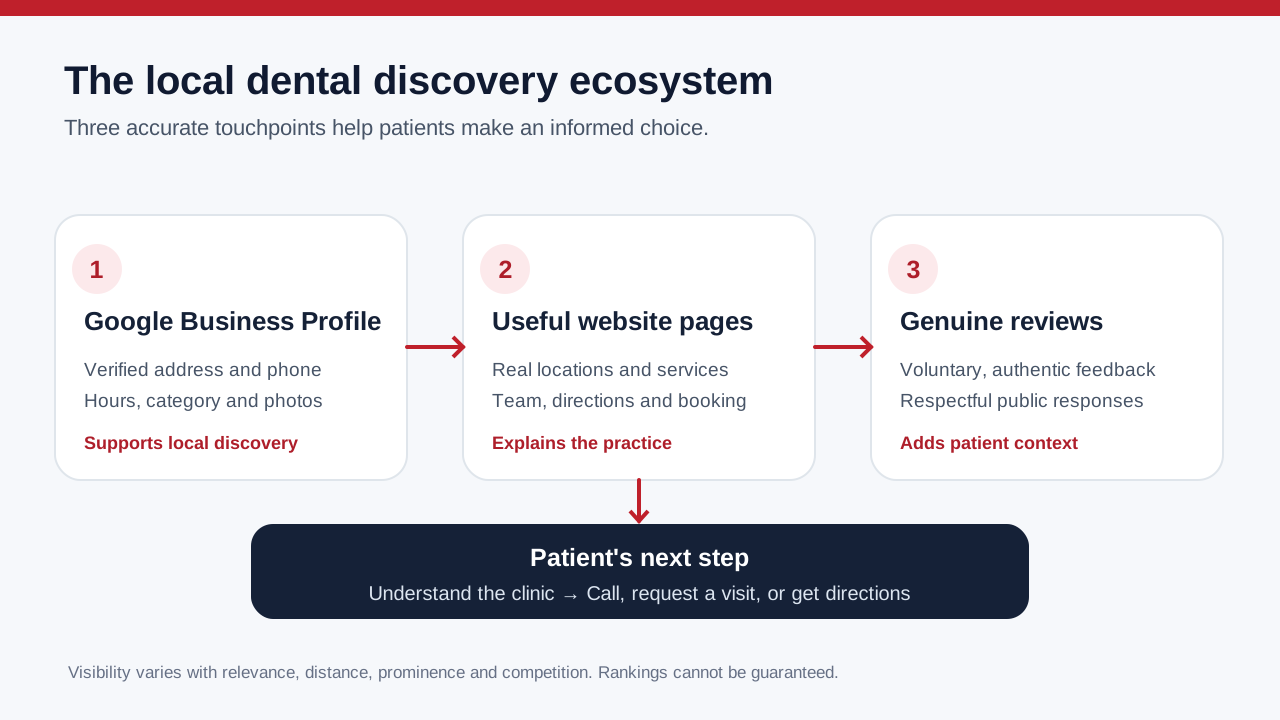
Patients use several signals together; accurate details across those touchpoints reduce confusion.
Consider this example: a prospective patient finds your Google Business Profile, taps through to your implant consultation page, reads about the assessment process, checks clinician information, and requests an appointment for the correct office. Each part has a different job. The profile supports discovery, the service page answers questions, and the booking pathway turns interest into contact.
Step 4: Earn reviews honestly and respond carefully
Use a consistent post-visit process to invite honest feedback, including feedback that may be critical. Do not purchase reviews, invent patient identities, or selectively pressure happy patients. Follow the platform's current review policies and applicable professional obligations.
Reply respectfully without revealing whether someone is a patient, describing treatment, or discussing private health information in public. For sensitive concerns, invite contact through an appropriate private channel.
Step 5: Make your dental website technically easy to understand
Google needs to discover your content. Check that important pages return a successful HTTP status, are not blocked by accidental noindex directives, have descriptive titles and headings, and are linked from the site's navigation or relevant service pages. Use mobile-friendly layouts, compressed images, descriptive alt text, and accessible buttons.
If supported by your actual page content, accurate business structured data may help search engines interpret the practice's name, address, and contact information. Structured data is not a substitute for a truthful page, and it cannot promise search-result features.
Read our dental website design checklist for a broader usability review. For answer-style pages that can help searchers evaluate treatment options, see our dental website AEO guide.
Step 6: Connect local visibility to real appointment outcomes
Rankings alone do not reveal whether new patients can use the website. Watch metrics such as clicks to the website from your profile, calls, directions requests, organic landing pages, and completed appointment requests. Review them over a meaningful period while accounting for seasonality and attribution limits.
Use tracking responsibly: appointment details, symptoms, identifiers, and other health-related information require privacy review before being sent to analytics or advertising vendors. For regulated clinics, have appropriate teams assess tracking and vendor arrangements.
A practical 30-day dental local SEO plan
Week 1 — Audit accuracy. Confirm Google Business Profile ownership, hours, address, phone, website, and appointment link. Document differences across the actual website and major listings.
Week 2 — Fix patient journeys. Select the three most important services. Make each page answer patient questions and include the correct location, phone, and appointment action.
Week 3 — Improve trust and usability. Add current, permissioned office images; update team information; test mobile navigation and forms; establish an ethical review-request process.
Week 4 — Measure and refine. Check page indexing, click-through paths, booking errors, and the quality of incoming questions. Prioritize fixes that help patients complete a real task.
This plan is a starting point, not a promise of results in 30 days.
Frequently asked questions
Is Google Business Profile optimization the same as dental SEO?
No. Business Profile optimization focuses on accurate local listing information and engagement. Website SEO also includes crawlability, service content, usability, links, and helping people understand the practice once they arrive.
Can one dental website rank for multiple locations?
It can serve multiple legitimate offices through distinct, accurate location pages and related signals. Rankings vary by query and searcher location. Avoid creating fake locations or duplicate doorway pages.
Are more reviews always better?
Review quantity is not a substitute for authenticity, recency, relevance, or good patient experience. Never manufacture reviews or disclose patient details in public replies.
How long does local dental SEO take?
There is no universal timetable. Competition, website history, actual location, content quality, and technical issues all affect outcomes. Measure progress consistently rather than expecting a fixed ranking date.
Give local patients a website worth visiting
VitalDesk's customized dental website services can bring together location-aware service content, mobile-friendly inquiry paths, and Google Business Profile optimization planning—based on the practice's real offerings and business details.
Next step: Explore custom dental website services from VitalDesk, or start with the online appointment booking guide to check whether your booking pathway matches what the website promises.
Editorial references: Google: Tips to improve local ranking; Google Search Essentials; HHS online tracking guidance.
Plan your custom dental website
Discuss the practice services, patient questions, booking workflow and location details that your website needs to communicate.
Explore custom websites